
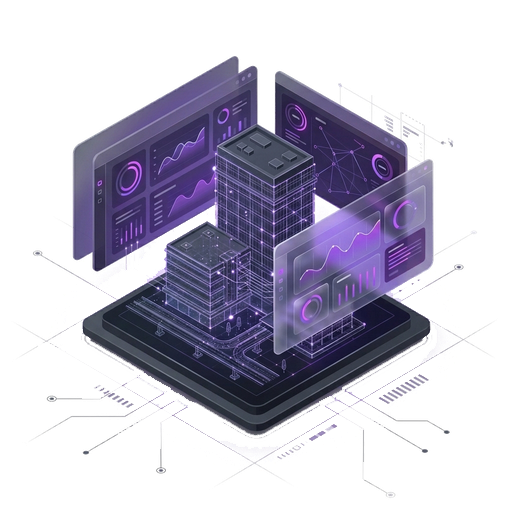
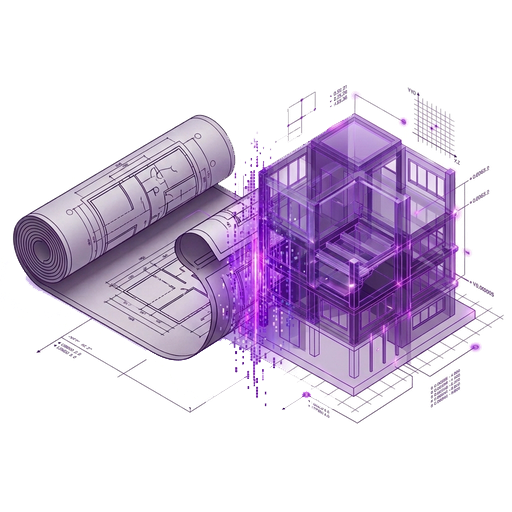
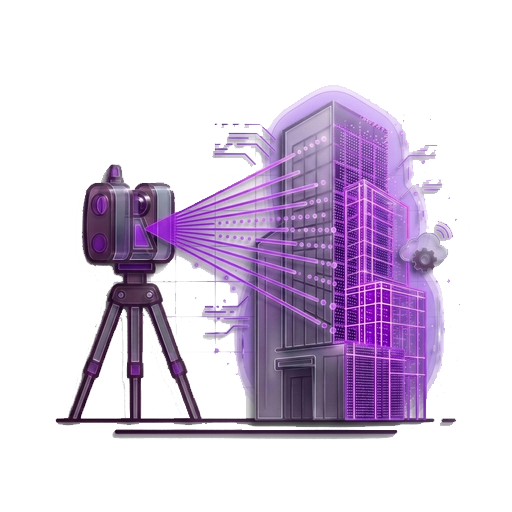

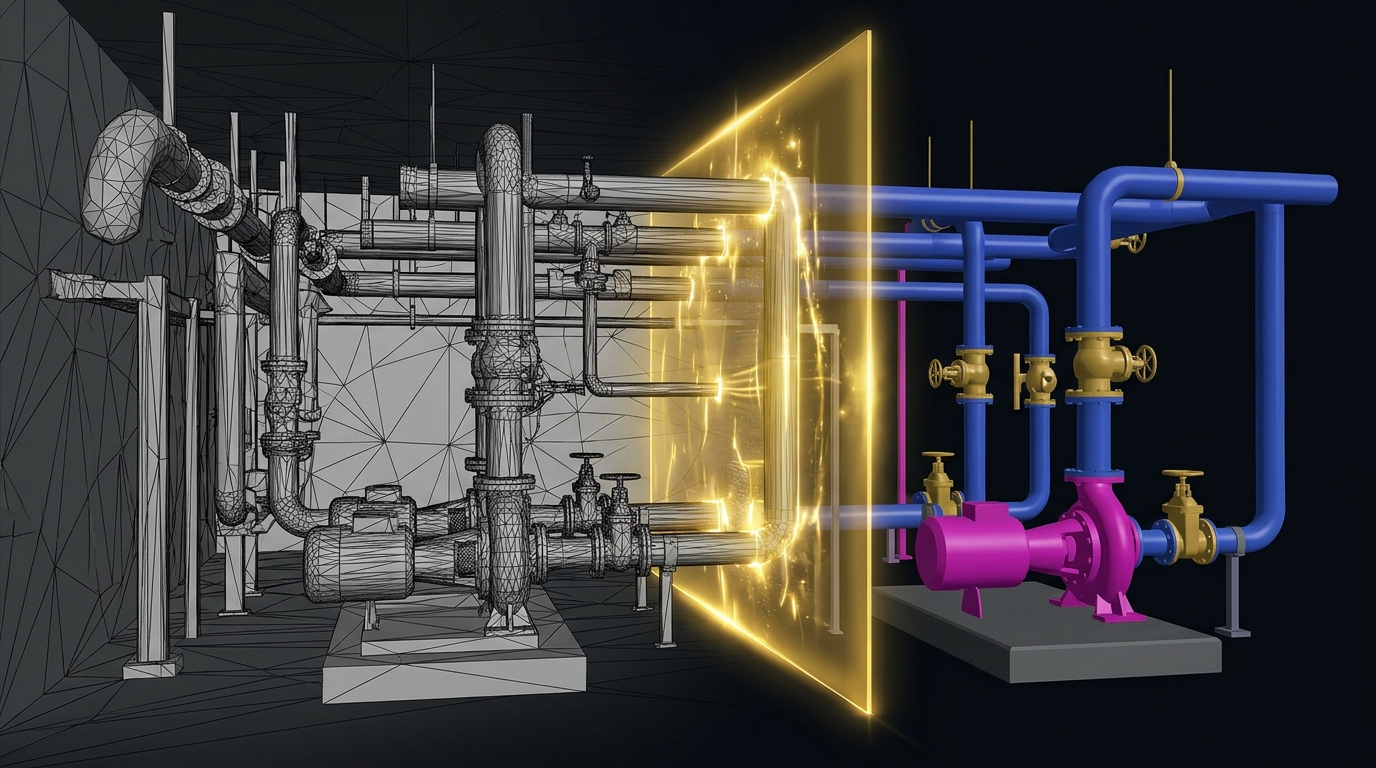
When a reality capture survey is completed—whether by an autonomous drone flying around a 30-storey facade or a mobile LiDAR scanner walking through a boiler room—the raw technical output is typically a point cloud (billions of discrete X,Y,Z coordinates) or a triangular polygon mesh (millions of connected triangles forming a continuous visual surface).
While these photogrammetric meshes look visually breathtaking, from a facility management and fiduciary accounting standpoint, they are computationally "dumb." The computer knows where each triangle exists in 3D space, but it has no idea that a specific cluster of 50,000 triangles is a Viessmann 1.2M BTU boiler, while an adjacent cluster is a concrete shear wall or a 2-inch domestic hot water copper line.
Defining Objectification
Without objectification, you have a beautiful video game set. With objectification, you have an actionable, statutory asset registry where every pump, elevator cab, membrane, and electrical panel has an individual digital identity.
The Step-by-Step Computational Workflow
How does Tucker Technology Consulting transform unstructured point clouds into intelligent 5D BIM entities?
- 1. Geometric Segmentation & Noise Filtering: Algorithmic segmentation filters isolate distinct physical geometries, stripping away temporary objects (furniture, parked vehicles, maintenance tools) and grouping contiguous surface normals.
-
2. Semantic Classification:
The isolated cluster of triangles is classified against international building ontologies (such as buildingSMART IFC4 schema or MasterFormat). The software assigns an entity class—for example,
IfcBoiler,IfcRoof, orIfcPump. - 3. Parametric Reconstruction: The jagged triangular mesh is replaced or wrapped by an exact parametric mathematical object. For a pipe run, this means calculating its true centerline, nominal diameter, wall thickness, and slope. For a roof, it means calculating the exact planar surface area, perimeter curb length, and drain pitch.
-
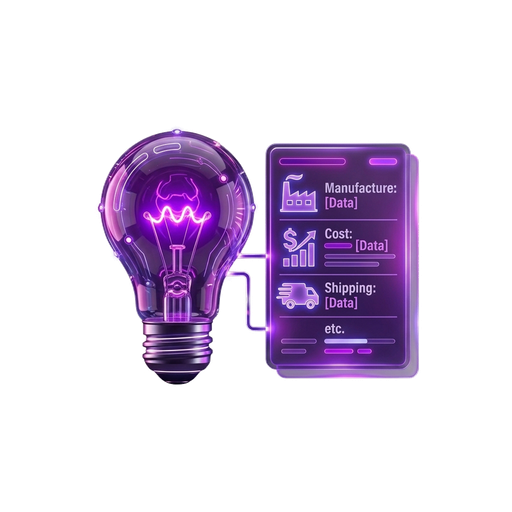
4. Fiduciary Data Binding (The "Every Object Has Data" Rule):
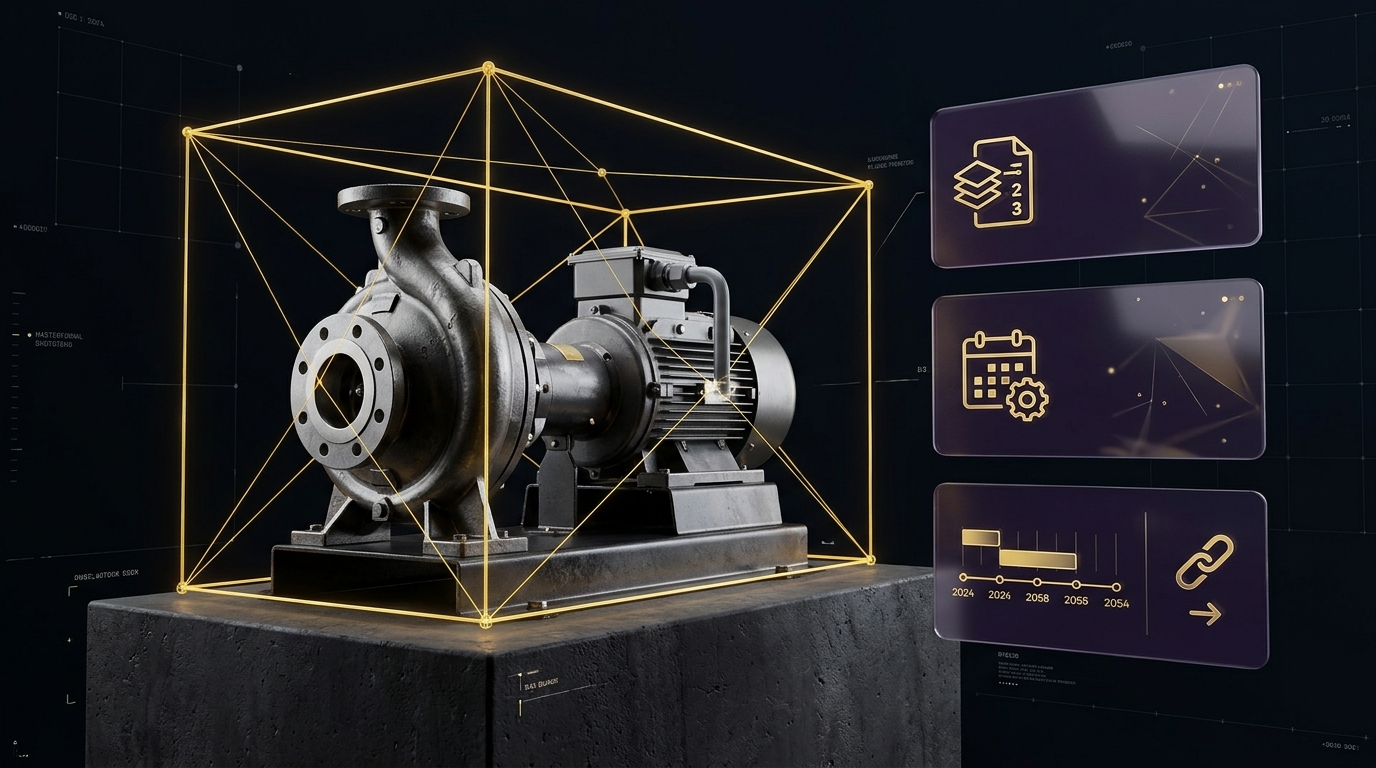
Once an object exists, it is populated with operational parameters mandated by BC Strata Property Regulation 6.2:
- Unique Spatial Asset ID: (e.g.,
BLR-1002) - Manufacturer & Model: Viessmann Condensing Boiler 1.2M BTU
- Installation Date & Observed Condition: Installed 2018; Condition: Good
- Remaining Useful Life (RUL): 14 Years (Target renewal: 2040)
- Replacement Cost: $185,000 CAD
- Service Records & Warranty: PDF hyperlinks directly accessible by clicking the 3D object.
- Unique Spatial Asset ID: (e.g.,
Why Objectification Protects Strata Fiduciaries
When an un-objectified mesh is handed to an engineer, they still have to manually measure and count components by eye. But when a fully objectified 5D BIM model is delivered:
- Automated Component Schedules: The model generates the entire Regulation 6.2 inventory table in seconds with 100% mathematical accuracy.
- Instant Spatial Search: A council member can search for "all isolation valves older than 15 years", and the 3D twin instantly highlights them in glowing amber across the building cross-section.
- Permanent Audit Trail: Contractors bidding on boiler replacements or roof renewals receive verified parametric specifications, eliminating contractor disputes and surprise cost variations.
Read foundational computer vision, semantic segmentation, and openBIM schema research:
- buildingSMART: IFC4.3 Schema Specification & Entity Classification — Global standard definitions for building components (IfcBuildingElement, IfcDistributionElement).
- IEEE TPAMI: Semantic Segmentation of 3D Point Clouds — Scientific literature on deep learning methods for point cloud classification and geometry reconstruction.
- ACM SIGGRAPH: 3D Surface Reconstruction & Polygon Meshes — Core computer graphics research on converting dense spatial measurements into parametric surfaces.
- Open Geospatial Consortium (OGC): CityGML 3.0 Standard — International open data model for storing and exchanging virtual 3D city models with semantic attributes.