
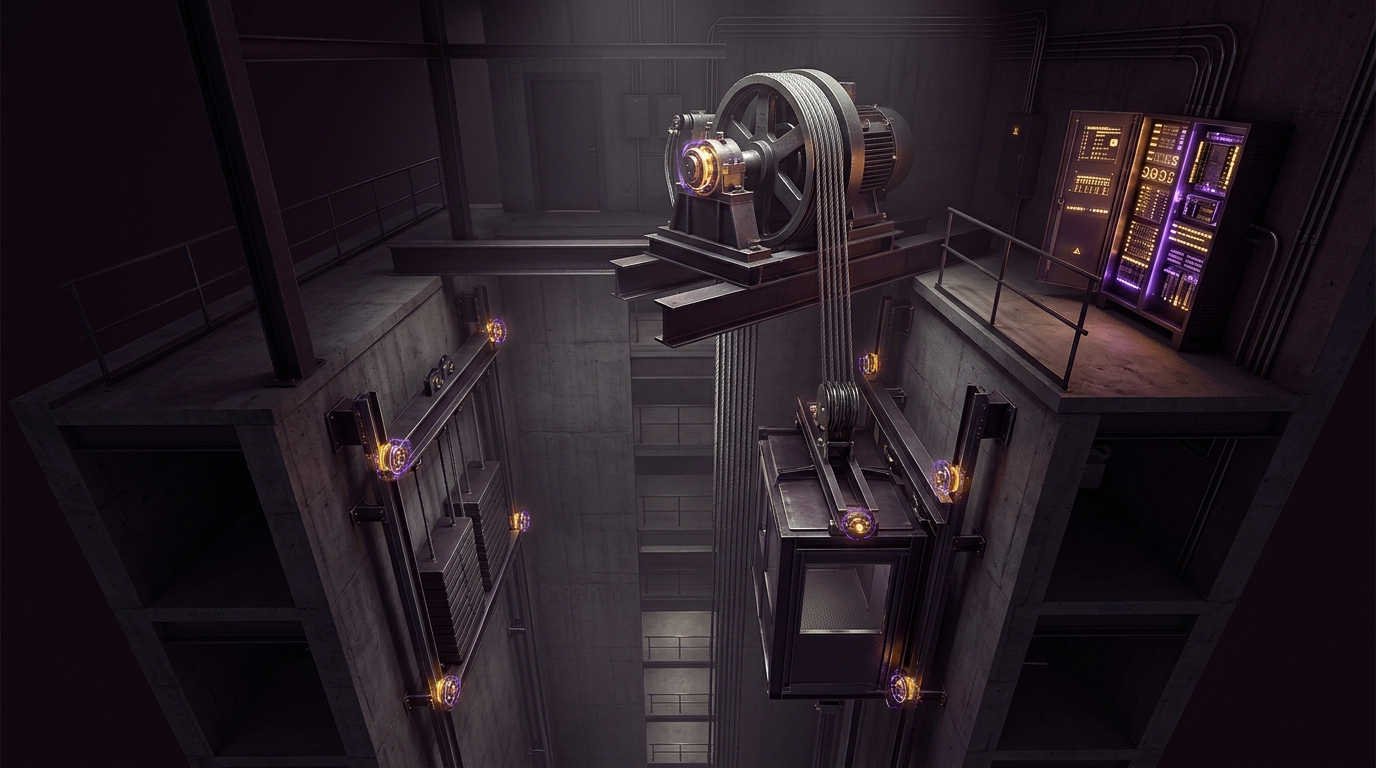
At nearly every Annual General Meeting (AGM) across British Columbia, the same peculiar dynamic plays out: the strata council and owners spend forty-five impassioned minutes debating a hairline crack or minor water efflorescence on the P2 parkade slab. Meanwhile, in the locked mechanical penthouse overhead, the building's 25-year-old traction elevator hoist machines, DC motor-generator sets, and obsolete relay controllers are quietly marching toward catastrophic obsolescence—an impending $250,000-per-cab capital crisis that nobody mentions.
The Parkade Crack Paradox: Why We Focus on What We Can See
In behavioural economics, the "Law of Triviality" (or bike-shedding) states that organizations disproportionately allocate time and emotional energy to trivial, easily understood issues while avoiding complex, monumental ones. In multi-family strata corporations, this phenomenon has a physical address: the parkade floor.
Every resident drives across the parkade slab twice a day. They see the cosmetic hairline settlement fissure. They see the dry salt stain from rainwater dripped off an SUV tire. Because it is visually prominent and intuitive to grasp, it generates frantic work orders, contentious council emails, and expensive structural engineering callouts to inject $3,500 worth of cosmetic epoxy.
Concrete slabs are designed to crack. Controlled micro-shrinkage is routine in reinforced concrete post-tensioned construction. Unless accompanied by active hydraulic water penetration through the structural waterproofing membrane, rust bleed from reinforcing rebar, or structural shear displacement, that surface fissure is rarely a life-safety or capital-threatening emergency.
The Fiduciary Blindspot
Stratas do not run out of money because of surface concrete shrinkage. Stratas enter insolvency, trigger crippling $20,000+ special levies, and lose insurance coverage because of unseen, unmanaged mechanical and electrical lifecycles—systems buried inside locked machine rooms, dry risers, boiler hubs, and electrical switchgear vaults.
The $250,000 Elevator Reality Check
Elevators are a residential tower’s single most critical, expensive, and logistically unforgiving vertical transit asset. They are also among the most frequently mismanaged components in strata reserve fund planning.
Consider the real-world economics of an elevator modernization in British Columbia:
- Capital Cost: Modernizing a single geared or gearless traction elevator (replacing hoist machines, cab interiors, traveling cables, regenerative drives, solid-state controllers, door operators, and hall lanterns) costs between $150,000 and $250,000+ CAD per cab. For a twin-cab mid-rise or high-rise, council faces a sudden $350,000 to $500,000 capital demand.
- Manufacturing Lead Times: Custom elevator hoist machinery, safety gears, and micro-processor controllers cannot be bought off the shelf. Fabrication and shipping from major manufacturers (Otis, Schindler, KONE, TK Elevator) frequently takes 6 to 12 months from contract execution.
- Obsolescence Without Warning: Many buildings constructed in the 1990s and early 2000s rely on proprietary electronic circuit boards whose original manufacturers have gone out of business. When an obsolete relay board fries, maintenance technicians cannot obtain replacement chips. The cab is tagged out of service indefinitely.
- The Human Impact: In an 18-storey tower with two elevators, losing one cab cuts vertical transit capacity by 50%. Morning rush-hour wait times surge past 20 minutes, mobility-impaired residents are functionally imprisoned in their homes, emergency paramedics face delay, and property values plummet as prospective buyers note the out-of-order signs.
When an unmonitored elevator system finally suffers terminal failure without a funded reserve, council has zero negotiating leverage. They are forced to pass an emergency special levy under Section 98 of the Strata Property Act, imposing sudden $15,000 to $25,000 cash calls on fixed-income retirees, young families, and working owners.
Other Silent Capital Killers in Multi-Family Buildings
The elevator is not alone. The built environment is riddled with hidden systems that operate silently until catastrophic failure forces council into crisis governance:
| Building Component | The Visual Illusion | The Hidden Engineering Reality | Catastrophic Cost Risk |
|---|---|---|---|
| Elevator Traction Systems | "The cab looks clean and the buttons light up fine." | Obsolete DC motor-generators, worn worm gears, and unserviceable proprietary relay controllers nearing end-of-life. | $150k – $250k / cab + 9-month lead time |
| Domestic Water Risers | "Water pressure is strong at the kitchen sink." | Internal galvanic copper corrosion and nocturnal micro-leaks quietly corroding pipe chases behind suite drywall. | $100k – $250k water deductible per claim |
| Main Electrical Switchgear | "The lights turn on; the breaker has never tripped." | Thermal oxidation, corroded bus duct connections, and zero capacity headroom for mandatory EV charging (SPA s.94.1). | $75k – $180k emergency replacement |
| Parkade Suspended Slabs | "There is a small hairline crack on the drive aisle." | Normal structural shrinkage. The true risk is membrane debonding allowing road salts to corrode post-tensioned tendon cables. | $2k cosmetic epoxy vs. $400k structural re-decking |
| Hydronic Heating Valves | "Baseboards feel warm in the winter." | Seized 2-way zone valves forcing boilers to short-cycle 24/7, burning $15k/yr in wasted gas and burning out circulation pumps. | $40k – $80k early boiler replacement |
The Unfair Burden on Strata Councils: Non-AECO Volunteers
Why does this happen over and over across British Columbia? The answer is simple, human, and deserves immense empathy:
Serving on a strata council is one of the hardest, most thankless volunteer roles in modern society.
Council members are not architects, structural engineers, mechanical technologists, or building envelope specialists. They are accountants, school teachers, nurses, retirees, software developers, and small business owners who stepped forward out of civic duty to protect their homes and communities.
Yet, under Section 31 of the Strata Property Act [SBC 1998] c. 43, these unpaid volunteers are held to a rigorous legal standard of care:
BC Strata Property Act — Section 31 (Standard of Care)
"In exercising the powers and performing the duties of the strata corporation, each council member must (a) act honestly and in good faith with a view to the best interests of the strata corporation, and (b) exercise the care, diligence and skill of a reasonably prudent person in comparable circumstances."
How can a volunteer council member exercise "the care, diligence and skill of a reasonably prudent person" when:
- Their Asset Memory is Fragmented: Past maintenance records are buried in unsearchable PDF email attachments, physical banker boxes in the basement, or lost entirely when property management brokerages change.
- Their Depreciation Reports are 200-Page Static PDFs: Traditional reserve studies sit unread on a shelf—dense actuarial tables without 3D spatial context, leaving volunteers unable to verify whether a quote from an HVAC contractor is reasonable or if the component was replaced four years ago.
- They Suffer From Institutional Amnesia: When dedicated council members step down after years of service, their hard-won knowledge of where the water shut-off valves are, which elevator hoist motor was rebuilt, and when the roof warranty expires vanishes overnight.
What If Your Walls Could Talk? What If Your Building Had a Brain?
This is precisely where Tucker Technology Consulting (TTC) transforms strata governance.
We do not believe volunteer fiduciaries should have to become licensed mechanical engineers to govern their buildings safely. Instead, we give your building a brain—replacing dead paper blueprints and static engineering reports with a living spatial asset register and 5D digital twin.
How TTC Gets Your Building Talking
When you give your strata a spatial twin, your building talks to you with absolute, undeniable clarity:
- It Tells You Where It Is Performing Well: Instantly view the systems that have been diligently maintained—confirming that the domestic hot water boilers have verified annual combustion logs, the roof membrane is under active warranty with drone-verified drainage, and your reserve fund contributions match 30-year lifecycle expectations.
- It Warns You Where It Is Quietly Bleeding Capital: See heat maps of escalating maintenance call frequencies. If an elevator has required twelve emergency service visits in six months, the platform flags the trend in bright red before the motor seizes, giving council the data needed to schedule a planned modernization rather than an emergency shutdown.
- It Gives Every Valve and Motor a Spatial Address: When a pipe bursts at 2:00 AM, property managers and on-call council don't scramble through disorganized binders. They open the digital twin on any smartphone, tap the affected suite, and immediately see the exact shut-off isolation valve location with 3D mechanical tracing.
- It De-Scopes Future Statutory Engineering Fees: Because all maintenance events, equipment serial numbers, and physical dimensions are continuously logged in an open ISO/IFC schema, your designated qualified engineer under SPR 6.2(6) receives a turnkey audit packet—cutting future 5-year statutory Depreciation Report renewal costs in half.
The AGM Transformation: Passing Capital Votes Without Shouting Matches
The true test of strata governance occurs in the community room at the AGM.
When a council presents a $200,000 elevator reserve allocation using only a spreadsheet line item, skeptical owners vote it down. Owners assume the council is overspending, or they demand that the money be redirected to pave the parkade or paint the lobby.
When council opens the TTC Strata Executive Dashboard in AGM Presentation Mode, the conversation completely shifts.
Owners see the 3D model of their building. They see the physical elevator shaft highlighted in amber, accompanied by the maintenance history log, manufacturer obsolescence notices, and verified lifecycle curves. They see that the parkade slab was professionally scanned and verified structurally sound, while the elevator hoist motor is 28 years into a 25-year design life.
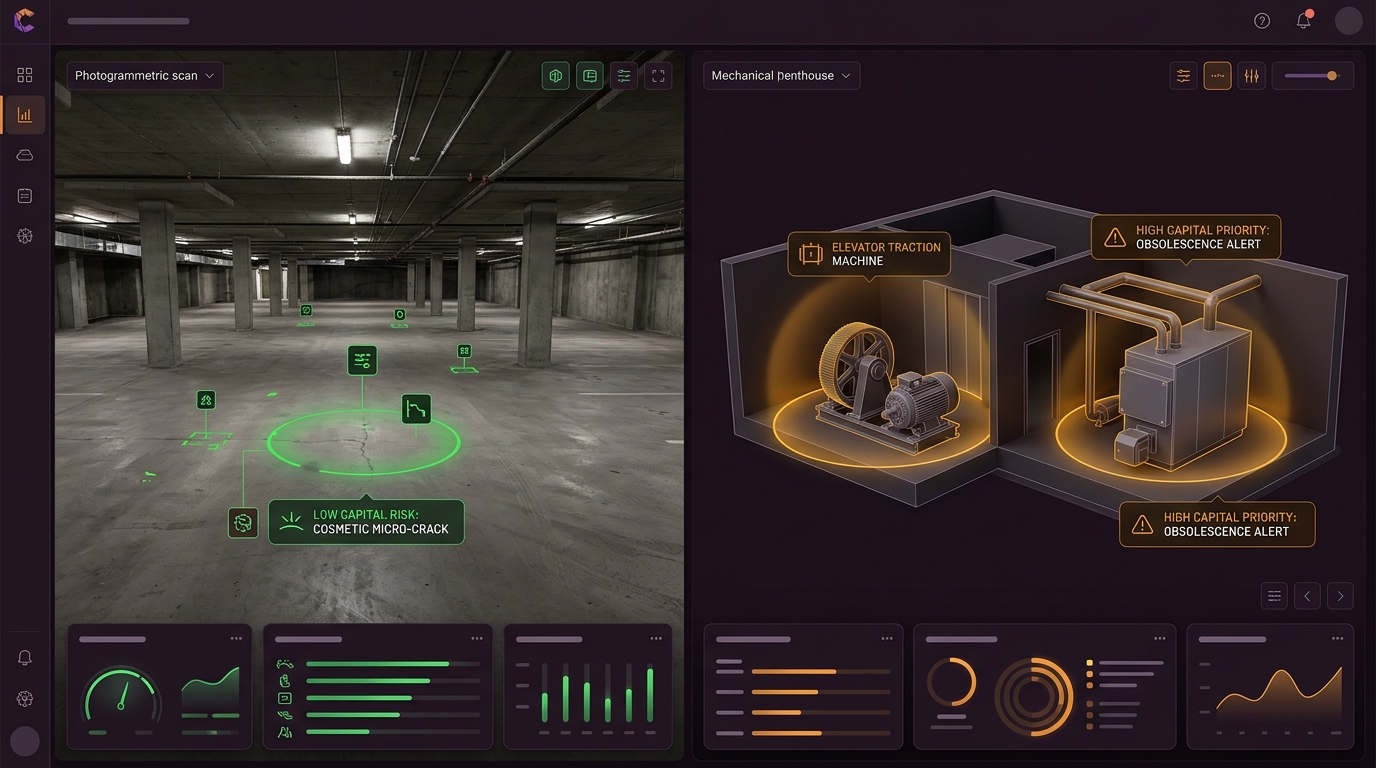
With objective spatial evidence, suspicion evaporates. The 3/4 vote passes smoothly, the reserve fund is prudently deployed, and the building is insulated against financial crisis.
Make Your Building Talk About What Matters
Your council members are doing heroic, unpaid work to protect your community's largest investment. Give them the spatial tools, institutional memory, and engineering clarity they need to govern with confidence.
Statutory & Governance References
Official British Columbia statutory authorities governing council duty and reserve fund planning:
- BC Laws: Strata Property Act [SBC 1998] c. 43, Section 31 (Standard of Care for Council) ↗ Statutory standard requiring council members to act in good faith and exercise the care of a reasonably prudent person.
- BC Laws: Strata Property Act [SBC 1998] c. 43, Section 94 (Depreciation Reports) ↗ Mandatory 5-year cyclical reserve study requirement post-Bill 44.
- BC Laws: Strata Property Act [SBC 1998] c. 43, Section 98 (Emergency Expenditures) ↗ Legal mechanism governing emergency unapproved expenditures when safety or critical assets fail.
- Technical Safety BC · Elevating Devices Regulatory Framework ↗ Provincial safety jurisdiction overseeing elevator operating permits, inspections, and modernization compliance.