
Over the past decade, consumer electronics has completely reshaped the modern domestic landscape. For a few thousand dollars, a homeowner can voice-command their window shades, program Philips Hue bulbs to cycle through 16 million colors, unlock deadbolts with an Apple Watch, and adjust heating schedules from a beach in Cabo. We have digitized convenience, entertainment, and front-porch package surveillance to an extraordinary degree. Yet, when an elbow fitting on a second-floor ensuite PEX supply line slowly stresses and begins leaking into the ceiling cavity below, that same $2 million "smart home" is functionally as deaf, dumb, and blind as a farmhouse built in 1890.
I. The Smart Home Illusion: Ambient Comfort vs. Physical Survival
The fundamental paradox of the consumer smart home industry is that it focused entirely on cosmetic interaction while ignoring physical building stewardship. Silicon Valley gave us gadgets to tweak the environment around us, but built virtually nothing to monitor the health, geometry, and mechanical longevity of the physical structure housing us.
Consider what your existing smart home devices actually do:
- Smart Thermostats: They measure the ambient air temperature in your main living hallway to optimize furnace run-times. They cannot tell you that an uninsulated exterior wall cavity in your north bedroom is sitting at -5°C, turning a fire-sprinkler run into an impending freeze-rupture disaster.
- Smart Video Doorbells: They record couriers dropping off groceries, but have zero visibility into whether your roof parapet flashing has lifted under a 70 km/h coastal windstorm.
- Smart Lighting & Audio: They illuminate your living room when you walk in, but have no memory of where the concealed in-wall junction box was buried during the 2018 kitchen remodel.
The systems that make a home pleasant to live in are trivial in cost compared to the systems that keep it standing. When an appliance fails, you replace it. When a concealed mechanical or envelope assembly fails, you enter a world of structural demolition, insurance deductibles, toxic remediation, and months of displaced living.
The Consumer Tech Blindspot
Consumer IoT digitized user convenience. It completely abandoned architectural reality. A home is not an iPad with drywall; it is a complex, breathing mechanical system composed of thousands of concealed joints, hydraulic conduits, electrical distribution runs, and structural load points.
II. The "Exploratory Demolition" Tax in Modern Residences
Modern high-end residences—from contemporary 1-bedroom urban penthouse apartments to multi-million-dollar Whistler chalets and Okanagan lakefront villas—are architectural marvels. They feature flush drywall reveals, seamless custom millwork, concealed pocket doors, curbless Italian-tiled walk-in showers, and integrated hydronic radiant floor heating.
Every one of these luxury architectural details makes traditional maintenance exponentially more difficult. In older homes, mechanical systems were exposed in basements or framed in utility chases with accessible screws. In modern luxury construction, pipes, shutoff valves, and wiring are hermetically sealed behind $40,000 worth of bookmatched marble slabs, Venetian plaster, and acoustic slat paneling.
When a mechanical issue arises, the homeowner is hit with what we call the "Exploratory Demolition Tax":
- The Guesswork: An apprentice plumber arrives because water is showing up on the hardwood floor of the main hallway. He has no drawings, no as-built records, and no spatial memory of the building.
- The Sledgehammer: To find the source of the leak, he cuts three 12"x12" holes in pristine drywall, only to discover the pipe is actually traversing a chase two studs to the left.
- The Secondary Damage: By the time the leaking shutoff is reached, $5,000 of drywall, paint, and custom millwork has been sacrificed solely to provide sightlines to a $25 fitting.
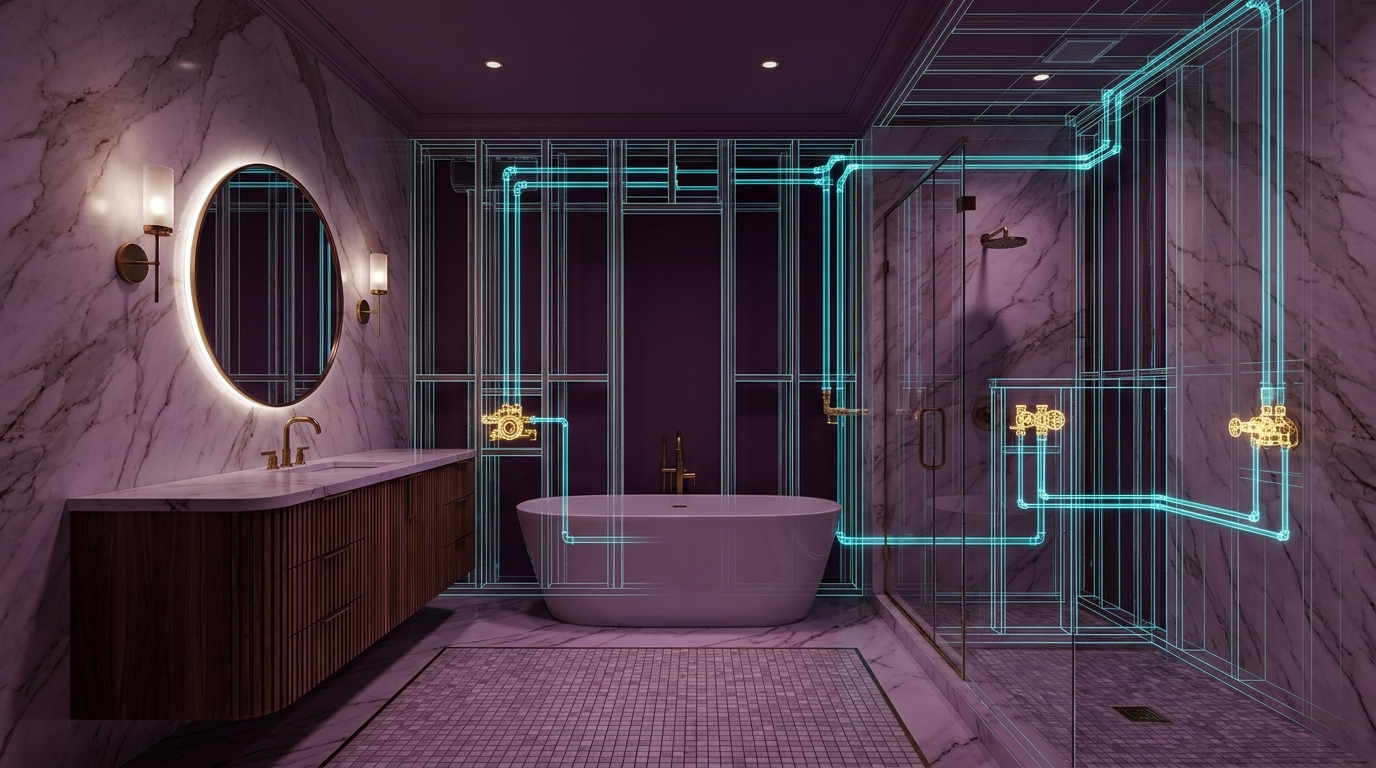
If the homeowner had a millimeter-accurate 3D spatial digital twin, the exact X-Y-Z coordinates of that shut-off valve, its riser clearance, and its isolation valve would have been visible on a phone screen before a single tool was unholstered.
III. The Vacation Home & Non-Primary Property Hazard
While maintenance blindspots are inconvenient in a primary residence, they are existential threats in vacation homes, secondary properties, and seasonal retreats.
Whether it is a ski condo in Whistler or Sun Peaks, a summer waterfront cabin in the Gulf Islands, a wine-country estate in Kelowna, or a recreational desert villa in Palm Springs, non-primary homes share a dangerous commonality: they sit completely unoccupied for weeks or months at a time.
| Incident Type | Primary Residence (Occupied) | Vacation Home (Unoccupied 3 Weeks) |
|---|---|---|
| Pinhole PEX / Copper Supply Leak | Spotted within 2 to 4 hours. Sound of hissing water heard; pooling noticed on tile. Immediate main shutoff. | Runs undetected for 21 days (~30,000 liters). Rots floor joists, destroys ceiling below, breeds black mold. $180,000+ rebuild. |
| Exterior Freeze Event (-15°C) | Occupants run faucets, adjust zone heating, notice sluggish water flow immediately. | Thermostat reads ambient 19°C from center hallway; exterior hose bib riser freezes, bursts, and thaws unnoticed. |
| Contractor / Service Callout | Owner meets technician, unlocks door, answers questions on where panels and valves are located. | Owner drives 3.5 hours each way or pays $250/hr travel charges for a contractor who arrives without proper parts. |
| Insurance Claim Scrutiny | Standard claim approved with basic deductible. | Denied under "Continuous Seepage" exclusion or failure to meet mandatory 48-hour occupancy inspection terms. |
The Dreaded "Continuous Seepage" Insurance Clause
Most homeowners assume their comprehensive property insurance policy has their back in the event of water damage. What many discover too late is that almost every Canadian and American underwriter includes a strict continuous or repeated seepage exclusion.
If a leak occurs and runs for more than 14 to 21 consecutive days before being discovered, insurance adjusters frequently classify the incident as a failure of maintenance rather than a sudden, accidental discharge. You are left bearing the entirety of a six-figure mold remediation and structural framing replacement out of pocket. Furthermore, many seasonal policies legally require a designated caretaker to physically enter and inspect the premises every 48 to 72 hours during heating months—a requirement that is virtually impossible for busy owners to consistently enforce.
IV. What a "Truly Smart Home" Actually Looks Like
A truly smart home does not just know how to play Spotify; it knows its own physical anatomy. It possesses a spatial brain—a living digital twin engineered from high-density LiDAR and Building Information Modeling (BIM) data that tracks the physical asset over its multi-decade lifespan.
The Three Pillars of Spatial Home Stewardship
- The 3D Spatial Ledger: A millimeter-accurate digital model of the structure, finishes, and hidden mechanical MEP risers accessible in any browser.
- Remote Coordination Gateway: A shareable digital asset that allows off-site owners to hand tagged 3D blueprints to contractors before they quote or arrive.
- Autonomous Physical Protection: Peel-and-stick wireless industrial IoT sensors tied directly to automatic motorized main water shut-off actuators.
1. Remote Tradesperson Coordination Without Leaving Your Desk
Imagine your vacation home’s heat pump fails during a January cold snap in Kelowna while you are working in your Vancouver office. Normally, this triggers a logistical crisis: calling multiple local contractors, paying emergency dispatch fees, trying to coordinate a key drop with a neighbor, and hoping the technician can find the auxiliary disconnect box.
With a living 3D digital twin:
- You text the technician a secure, browser-based 3D walkthrough link of the mechanical room.
- The technician clicks on the heat pump in the 3D model and immediately sees the exact unit model number, serial code, refrigerant specification, filter dimensions, and electrical breaker assignment.
- They pull the required compressor capacitor from their shop inventory before loading the truck. They arrive on site, go directly to the tagged equipment, perform the repair in 45 minutes, and leave. Zero return trips, zero wasted hours, zero guesswork.
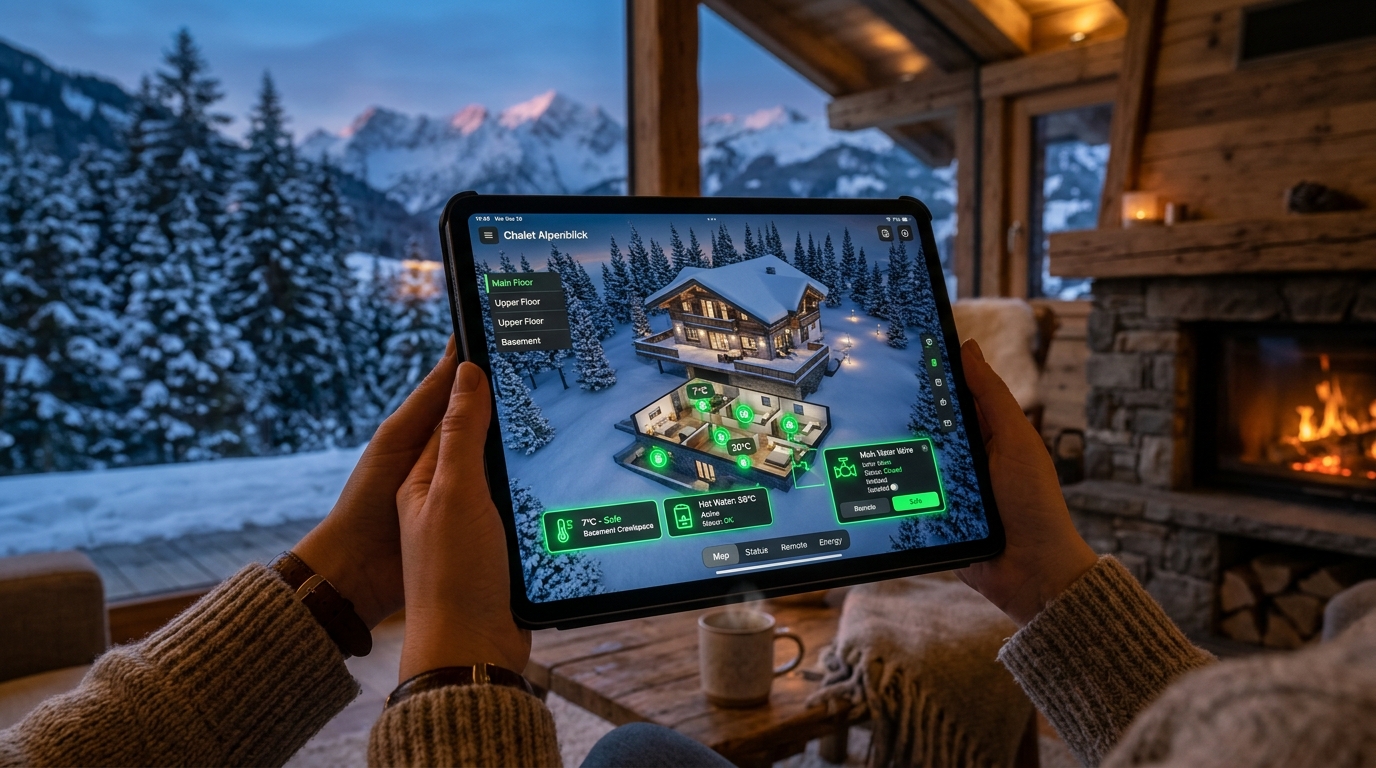
2. Autonomous IoT Moisture & Automatic Valve Shut-Off
Instead of relying on fragile Wi-Fi consumer leak detectors that drop offline when your router reboots, a professional spatial platform utilizes industrial sub-GHz wireless sensors (such as Disruptive Technologies or LoRaWAN). These sensors are the size of a postage stamp, operate for up to 10 years on internal battery power, and transmit through concrete foundation walls and steel studs.
Placed in high-risk zones—sump pump pits, boiler drip trays, under refrigerator ice makers, behind washing machine laundry boxes, and beside master ensuite soakers—they monitor moisture and temperature constantly. The moment a single droplet bridges the sensor contacts:
- A high-torque motorized ball valve on your primary municipal water intake closes in under 3 seconds, isolating the supply before a cup of water can pool.
- An emergency push alert pinpoints the exact 3D spatial location of the leak in your digital twin and notifies both you and your designated local property manager.
V. Pricing Architecture: From 1-Bed Condos to Luxury Private Estates
At Tucker Technology Consulting, we believe fiduciary spatial engineering should not be restricted to 80-storey skyscrapers and commercial institutions. The exact same computational rigor Brey Tucker applied as lead architectural technologist on the 1,260-foot PIF Tower in Riyadh is now accessible for individual private residences.
Our residential spatial management pricing is completely transparent and designed around long-term stewardship:
| Property Scale | Year 1 Upfront Onboarding | Years 2–5 Annual Service | Deliverables & Scope |
|---|---|---|---|
| Condo Apartments & Townhomes ~600 to 1,800 sq.ft |
$5,000 CAD Starting baseline |
$500 CAD / yr Years 2 through 5 |
Interior LiDAR scan, concealed plumbing shutoff tagging, breaker mapping, digital appliance & warranty ledger, browser 3D viewer. |
| Single Family Homes & Chalets ~2,000 to 4,500 sq.ft |
$6,500 – $9,500 CAD Scale based on sq.ft |
$750 – $1,200 CAD / yr Years 2 through 5 |
Full interior & exterior envelope capture, mechanical room MEP reverse-engineering, roof inspection model, IoT moisture sensor integration. |
| Luxury Estates & Waterfront Villas 5,000+ sq.ft + acreage |
Custom Proposal Starting at $12,000 CAD |
Custom Annual Tier Years 2 through 5 |
High-altitude drone aerial survey, outbuildings/guest house modeling, irrigation & septic spatial mapping, dedicated senior technologist liaison. |
* Note: Exact residential pricing is dependent on the square footage of the home, architectural complexity, and property lot size.
VI. The Absent Owner’s Fiduciary Checklist
If you own a vacation home, recreational cottage, or secondary residential property, perform this 5-point audit before your next extended absence:
- Do you know where the main water shut-off is? Not roughly in the crawlspace, but the exact handle. Does a family member or guest know how to isolate it in the dark with water spraying?
- Have you tested your main valve operation? Many residential gate valves seize in the open position after 5 years of disuse. When a leak occurs, turning the corroded knob does nothing.
- Can you direct a tradesperson to your mechanical shutoffs remotely? If an electrician needs to isolate your hot tub feeder while you are abroad, can you show them the panel without driving there?
- Are your freeze-sensitive zones monitored? Do you have temperature sensors in your crawlspace, well pump house, and attic soffits, or only in your central hallway?
- Do you have a permanent digital record of what is behind your walls? If you completed a luxury renovation, do you have photos or a 3D scan of the open framing, or did your contractor bury all pipes and wires without spatial documentation?
Give Your Home a Brain with Tucker Technology Consulting
Don't settle for consumer gadgets that only turn on lamps. Give your primary residence or vacation retreat the institutional-grade spatial intelligence it deserves. With a living 3D digital twin and structured asset ledger, you gain complete visibility, eliminate exploratory damage, and protect your equity permanently.
Authoritative Codes, Standards & Industry Frameworks
Provincial codes and international standards governing residential water isolation, insurance duty, and spatial twins:
- Insurance Bureau of Canada (IBC) · Residential Water Damage & Vacancy Guidelines ↗ Industry underwriting criteria governing frozen pipe exclusions, vacant property inspection intervals, and continuous seepage claim denials.
- British Columbia Building Code (BCBC) · Part 7 (Plumbing Facilities) ↗ Provincial code provisions governing required plumbing supply isolation valves, pressure relief systems, and backflow prevention.
- Digital Twin Consortium (DTC) · Capabilities Periodic Table Framework ↗ Global industry framework defining reality capture fidelity, spatial anchoring, and digital ledger synchronization for physical assets.
- buildingSMART International · Industry Foundation Classes (IFC4) ↗ Vendor-neutral open standard for MEP component classification and spatial facility management handovers.